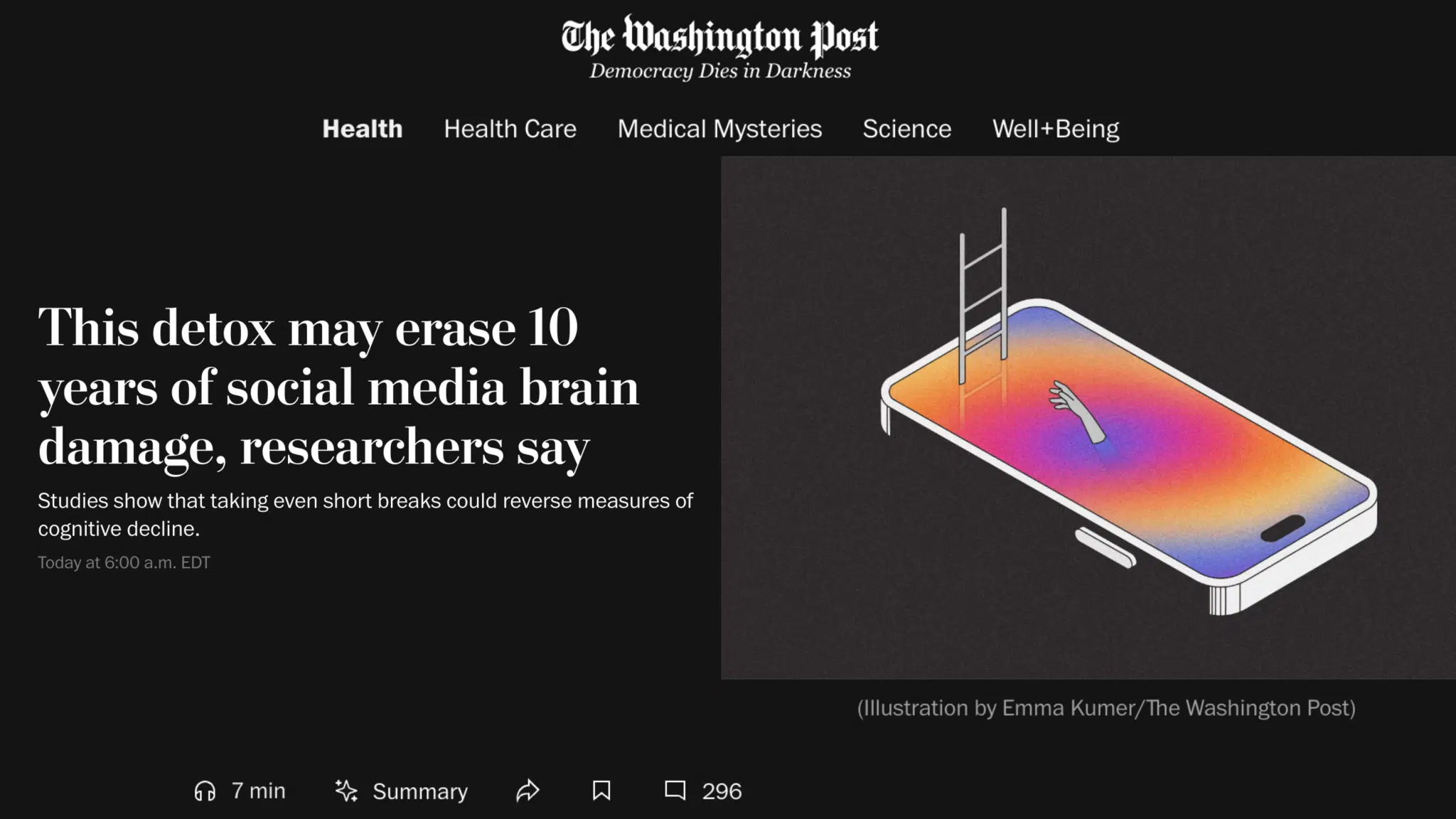
Is Passive Screen Time Quietly Increasing Your Dementia Risk?

TL;DR:
- Passive screen time (scrolling, autoplay, background TV) keeps your brain in low engagement mode
- Studies link high passive consumption, especially TV, to increased dementia risk
- Active screen use (learning, creating, social interaction) helps protect cognitive function
- Midlife habits matter most for long-term brain health
- Small shifts like turning off autoplay or creating before consuming can build cognitive reserve
Brain fog in your 30s or 40s isn’t just stress. It may be tied to how you use screens every day. Passive screen time, like scrolling, autoplay, or background TV, keeps your brain in low engagement mode. Over time, that pattern is being linked to higher risk of cognitive decline and dementia.
Recent research shows that not all screen time is equal. Activities that challenge your brain can protect it. Passive consumption does the opposite. It reduces cognitive stimulation during the years when your brain is most adaptable.
This guide breaks down what passive screen time actually does to your brain, how it connects to dementia risk, and what small changes can shift the trajectory.
Why Brain Fog In Midlife Isn’t Just Stress
Millennials did not expect this to be the midlife crisis. Not the mortgage stress or the career pivots, but the brain fog. The kind where you walk into a room and forget why, read a paragraph three times and retain nothing, or lose a word mid-sentence that you absolutely know.
In 2026, the conversation around cognitive decline is shifting fast. Dementia is no longer just an older generation concern.
Researchers are now pointing to midlife habits, specifically the passive and low engagement digital consumption habits that millennials have accumulated over a decade of smartphone use, as meaningful risk factors for long term brain health.
Dr. Daniel Amen, psychiatrist and brain imaging expert, has been saying this for years. His SPECT brain scans show measurable differences in brain activity between people who engage in mentally stimulating activities versus those stuck in passive consumption patterns.
“What you do every day matters more than what you do once in a while” – Gretchen Rubin
Passive scrolling is now something most millennials do every single day, often for hours.
Not all screen time is the same.
Active, intentional screen use (learning, creating, connecting) works your brain. Passive screen time keeps content flowing while your brain checks out.
That distinction, played out over years, may matter more than anyone initially realized. Let’s get to the heart of it.
Passive Screen Time: What It Means For Your Brain
Passive screen time is low engagement, high consumption digital behavior. You’re watching or doomscrolling, but you’re not creating, problem-solving, or meaningfully interacting. Your brain is in pure receive mode.
What counts as passive screen time in 2026?
In 2026, AI generated short form content has scaled passive consumption to a volume no human team could produce. The scroll is no longer just infinite. It’s adaptive, learning your attention patterns in real time and serving exactly what keeps you disengaged but hooked.
Passive screen time now looks like:
- Autoplay queues on Netflix, YouTube, or Reels that run for hours without a single active choice
- AI generated short form content flooding TikTok and Instagram faster than you can meaningfully process it
- Background TV streams designed to run for hours without demanding any attention
- Doom scrolling through news headlines without reading, analyzing, or retaining anything
What does active screen time look like instead?
Active screen time puts your brain to work. The screen is the same. The mental demand is completely different.
- Video calling friends and family (social connection is one of the strongest protectors against cognitive decline)
- Learning a new skill through a tutorial or online course
- Playing a strategy game or anything that requires decision-making
- Writing, editing, creating content rather than consuming it
That demand is precisely what builds brain resilience over time. And the difference between the two has real consequences.

What Is Dementia And How Does It Actually Show Up?
Before connecting the dots to screen time, it helps to understand what dementia actually is.
Because most people picture a grey haired person in dramatic, sudden decline. The reality is far more gradual, and that is exactly what makes early habits so important.
What is dementia?
Dementia is not a single disease. It is an umbrella term for a group of symptoms caused by damage to brain cells that affects memory, thinking, behavior, and the ability to carry out daily tasks.
Alzheimer’s disease is the most common form, accounting for 60 to 80 percent of cases. Others include vascular dementia, Lewy body dementia, and frontotemporal dementia.
The World Health Organization estimates that over 55 million people worldwide are currently living with dementia, and that number is projected to rise to 139 million by 2050.
How does dementia show up in everyday life?
This is where it gets personal. Dementia does not announce itself loudly. It tends to show up quietly, in ways that are easy to dismiss as stress, aging, or just being busy.
Early warning signs include:
- Forgetting recent conversations, appointments, or where you put things
- Struggling to find the right words mid-sentence
- Difficulty following instructions or multi-step tasks
- Losing track of dates, seasons, or time passing
- Mood changes, increased anxiety, or withdrawing from social activity
- Trouble concentrating or making decisions that used to feel simple
The critical thing to understand is that by the time symptoms show up, changes in the brain have typically been building for 10 to 20 years. Dementia is not something that happens to you suddenly at 70. It is something the brain moves toward slowly, shaped by decades of daily habits.
Research About Passive Screen Time And Dementia Risk
What do the studies actually show?
The science here is worth taking seriously.
The connection between passive screen time and dementia risk is supported by several large studies. Three major findings stand out:
- A landmark study in JAMA Neurology found that sedentary behaviors, particularly extended TV watching, were associated with a significantly higher risk of dementia, even after accounting for physical activity levels. Passive TV watching was linked to greater cognitive decline than computer based activities requiring active engagement.
- The UK Biobank study, analyzing data from over 400,000 adults, found that more than four hours of daily TV viewing was associated with increased risk of dementia, Alzheimer’s disease, and vascular dementia. Moderate computer use showed a protective association with cognitive health, suggesting it’s not about avoiding screens but about how your brain shows up while you’re on them.
Dr. Amen’s clinical work reinforces this. His brain imaging research consistently shows that low stimulation, high consumption lifestyles produce brain patterns associated with accelerated aging and reduced prefrontal cortex activity, the area responsible for decision-making, focus, and critical thinking.
The Cognitive Reserve Problem Millennials Need to Know About
What is cognitive reserve and why does it matter?
Cognitive reserve is your brain’s emergency backup capacity. Think of it as a savings account.
Every mentally demanding activity you do makes a deposit: learning a skill, having a deep conversation, solving a complex problem, creating something from scratch.
People with high cognitive reserve can have the physical markers of Alzheimer’s in their brain scans and still function well, because they’ve built enough neurological backup to compensate.
Passive screen time makes no deposits. Here is what happens when you scroll:
- Your prefrontal cortex, the brain’s seat of critical thinking and attention, largely goes offline
- The dopamine system gets a small hit from each new post, creating just enough stimulation to keep you going
- The higher cognitive functions that protect your brain long term stay quiet throughout
It is stimulating enough to hold your attention. It is not demanding enough to strengthen anything.
Why does midlife matter most for brain health?
Millennials are now in their 30s and 40s. Research identifies this as the critical window for building cognitive reserve.
The habits formed in midlife have an outsized effect on what your brain looks like at 65 or 75. Passive scrolling as a primary leisure activity during these years is not a neutral choice. It is a consistent vote cast against your future brain health.

The Dual Screen Problem No One Talks About
One specific pattern stands out as particularly damaging for brain health: dual screen passivity. The TV runs in the background while you scroll your phone, or your laptop stays open as you take “quick” scrolling breaks between tasks. Neither screen gets your real attention.
You are not engaging with the show. You are not truly registering the content you are scrolling past. Your brain sits in a state of low stimulation and high input, getting just enough sensory noise to feel occupied but not enough cognitive demand to actually do anything useful.
Dr. Andrew Huberman, neuroscientist and host of the Huberman Lab podcast, has highlighted how fragmented, low depth attention prevents the kind of neural consolidation that makes information stick and builds lasting cognitive strength.
Two passive screens at once is not double the stimulation. It is double the disengagement.
Making the Shift: From Passive Scrolling to Purposeful Use
Where do you start?
You do not need a complete digital overhaul. Small, deliberate changes to your digital consumption habits can meaningfully shift your brain health trajectory over time.
- Audit your screen time data honestly. Your phone already tracks this. Check your ‘Screen Time’ or ‘Digital Wellbeing’ report and look at which apps represent genuine use versus passive loops. Most people are genuinely surprised by what they find.
- Apply the create before you consume rule. Spend at least 10 minutes writing, drawing, or building something before opening any passive consumption app in the morning. It sets your brain’s default mode for the day toward output rather than input.
- Turn off autoplay everywhere. On Netflix, YouTube, and any platform that offers the option. Actively choosing the next thing is a small act of cognitive agency that adds up across hundreds of sessions.
- Protect your sharpest hours from passive consumption. Your prefrontal cortex is most active in the first two hours after waking. Blocking social media and streaming apps during that window, using a tool like Freedom to make that commitment stick across all your devices, protects your highest quality brain time for work that actually matters.
- Replace passive time with something that requires your brain to show up. A book, a phone call, a walk without headphones, setting up IKEA furniture, building Legos, a hobby that involves making something. The replacement is what makes the habit stick. Removing passive consumption without filling the space usually fails.
Your Brain Is Still Changeable. But the Window Matters.
Here is what the research on neuroplasticity makes clear: your brain can build new connections at any age.
It is not too late to shift course. But midlife, exactly where most millennials are right now in 2026, is the window that researchers consistently identify as most important for long term brain health outcomes.
The habits you build or break in your 30s and 40s show up in your brain health decades later.
Passive screen time will not cause dementia on its own. But as a daily default for hours at a time, it represents a consistent choice to keep your brain in a low engagement state during the years when stimulation matters most.
Your future brain is still being built right now. Less passive. More purposeful. That is a choice you can start making today.
If you’re looking to cut passive screen time and reclaim your focus, Freedom blocks distracting apps and sites across all your devices. Get intentional about your screen time with Freedom here.